

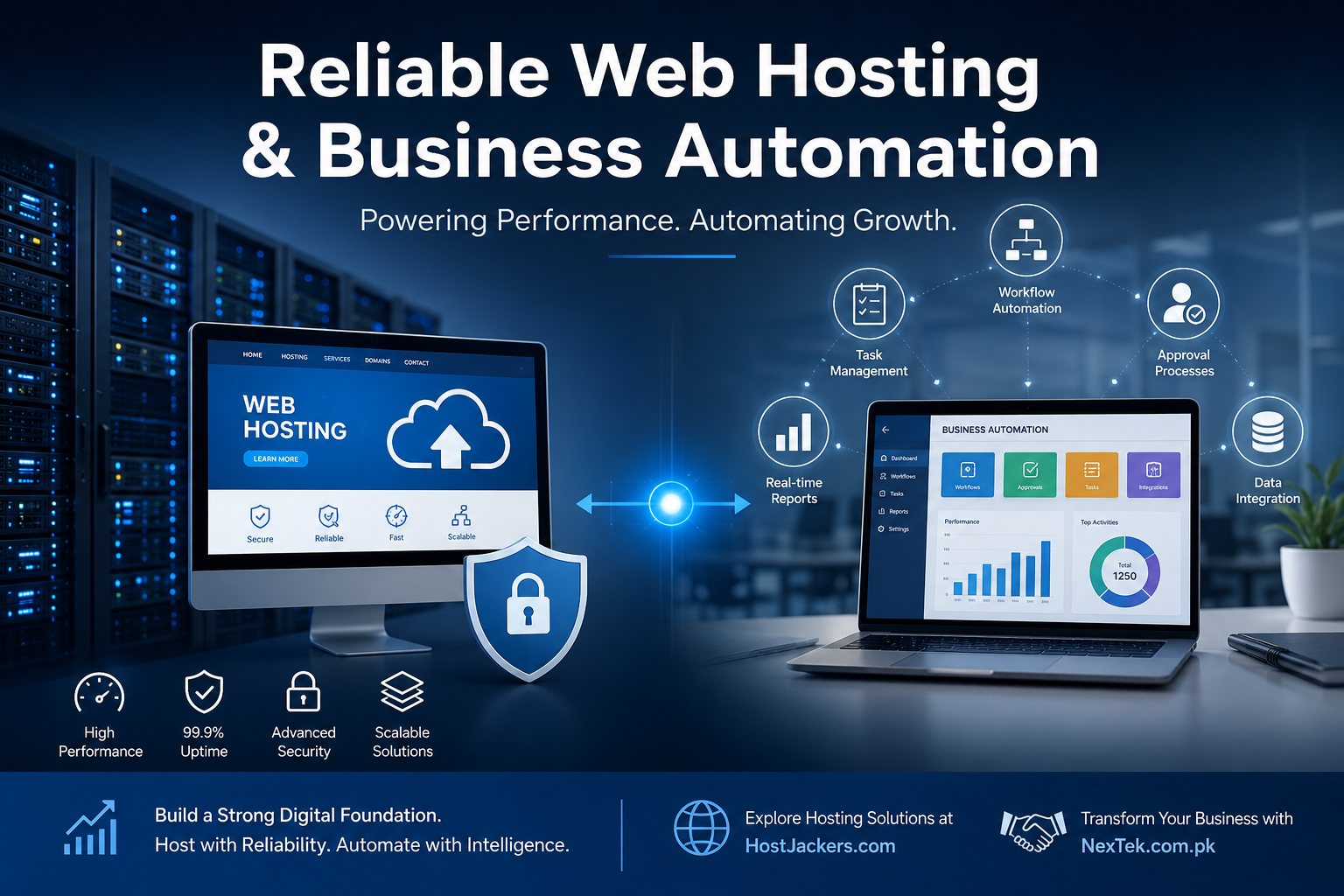

A successful digital business requires more than an attractive website. It needs a dependable technological foundation that keeps its website accessible, protects important information and supports the digital systems employees and customers use every day. This is where two essential elements come together: reliable web hosting and intelligent business automation.
Reliable hosting provides the infrastructure required to keep websites, portals and applications online. Business automation helps organizations improve internal workflows, reduce repetitive tasks and manage operations more efficiently.
When these technologies work together, businesses can create a faster, safer and more scalable digital environment.
A Business Website Is More Than an Online Brochure
In the past, many companies used their websites as simple digital brochures containing basic information about their products, services and contact details.
Modern business websites have a much broader role.
A website may now support:
- Customer inquiries and lead generation
- Online sales and payments
- Product and service catalogues
- Appointment bookings
- Customer support portals
- Employee access systems
- Cloud-based applications
- Supplier communication
- Business dashboards
- Document downloads and submissions
Because websites are becoming more closely connected to everyday business operations, choosing the right hosting solution is no longer a minor technical decision.
It can directly affect customer experience, online visibility, website security and business continuity.
Businesses developing a new online presence can explore the website development services available through HostJackers.
Why Reliable Web Hosting Matters
Web hosting is the infrastructure that stores website files, databases, email accounts and applications while making them available over the internet.
The quality of that infrastructure can influence almost every aspect of a company’s online performance.
1. Faster Website Performance
Website visitors expect pages to load quickly. Slow loading times can discourage users from exploring services, purchasing products or submitting inquiries.
Performance-focused hosting can improve the user experience by providing suitable server resources, optimized configurations, caching technologies and content delivery support.
Businesses looking for a performance-oriented solution can learn more about fast and secure web hosting from HostJackers.
2. Better Website Availability
A business website should remain available throughout the day.
Unexpected downtime may prevent customers from:
- Viewing products
- Contacting the company
- Completing transactions
- Accessing important information
- Signing in to online portals
- Submitting forms or documents
Reliable hosting helps reduce avoidable service interruptions and provides the technical environment required to keep essential online services accessible.
This is particularly important for e-commerce stores, SaaS platforms, professional service providers and businesses that serve customers outside standard office hours.
3. Stronger Website Security
Business websites often process valuable information, including customer details, account credentials, contact information and transaction records.
A secure hosting environment can support important protection measures such as:
- SSL certificates
- Secure server configurations
- Malware monitoring
- Automated backups
- Access controls
- Software updates
- Firewall protection
- Account isolation
Hosting alone cannot eliminate every cybersecurity risk, but it provides an essential layer of protection for websites and web applications.
4. Greater Scalability
A new website may initially receive limited traffic. As the company grows, its storage, processing, database and bandwidth requirements can increase.
Scalable hosting allows the business to upgrade its resources instead of rebuilding its entire online infrastructure.
Companies should therefore select a hosting plan based not only on their current needs but also on their expected growth.
Choosing the Right Hosting Environment
Different websites require different types of hosting.
A personal blog, business website, online store and enterprise web application may each have separate technical requirements.
HostJackers provides several options for different types of online projects.
WordPress Hosting
WordPress is widely used for company websites, blogs, news platforms and online stores.
A hosting environment optimized for WordPress can simplify installation, website management, backups, security and performance optimization.
Businesses using the WordPress content management system can review the available WordPress hosting plans.
Linux Hosting
Linux hosting is suitable for many websites and applications developed with technologies such as PHP, MySQL, Python and other open-source tools.
It can provide a flexible and cost-effective environment for developers, startups and growing companies.
More information is available on the Linux hosting page.
Business Web Hosting
Growing businesses may require more processing power, memory, storage, email capacity and database resources than a small website.
A dedicated business hosting package can provide additional resources for multiple websites, larger databases and increased online activity.
Companies can compare the available business web hosting options to find a plan suited to their operational requirements.
Reliable Hosting Is Only the Beginning
A well-hosted website can strengthen a company’s public online presence, but it does not automatically improve internal business operations.
Many organizations still depend heavily on:
- Scattered spreadsheets
- Paper-based requests
- Repetitive data entry
- Manual reporting
- Long email approval chains
- Disconnected applications
- Unstructured supplier communication
- Delayed management decisions
These processes can continue slowing down the organization even when its public website performs well.
This is why sustainable digital growth also requires business process automation.
What Is Business Automation?
Business automation uses software and digital workflows to reduce repetitive manual work and make processes more organized, consistent and measurable.
Instead of employees manually transferring information between departments, an automated system can:
- Route requests to the correct person
- Trigger approval workflows
- Generate notifications
- Maintain centralized records
- Produce reports
- Monitor deadlines
- Track changes
- Control user access
- Connect different business applications
Automation can be applied across several departments, including:
- Procurement
- Finance
- Human resources
- Sales
- Inventory management
- Customer service
- Delivery management
- Attendance management
- Document approvals
- Supplier management
For example, a manual procurement process may involve printed purchase requests, email approvals, telephone calls to suppliers and separate spreadsheets for comparing quotations.
An automated procurement platform can connect these activities within one organized workflow. Employees can submit requests, managers can approve them, suppliers can provide quotations and authorized teams can compare offers through a centralized system.
Technology providers such as NexTek help organizations modernize procurement, workflows and enterprise operations through business software and digital transformation solutions.
How Hosting and Business Automation Work Together
Web hosting and business automation may appear to serve different purposes, but they are closely connected.
Modern business systems are often accessed through web browsers. Employees, customers, suppliers and managers may need to use these applications from different locations and devices.
The hosting infrastructure supports the availability of these applications, while the software controls the underlying business processes.
Together, they create a connected digital ecosystem.
Hosting Supports Accessibility
The hosting environment allows websites, portals and web applications to remain available online.
Without dependable infrastructure, users may experience slow loading, connection errors or interrupted access.
Automation Supports Operations
Business software manages approvals, records, tasks, data and communication.
Without effective automation, employees may continue performing repetitive activities manually, even when the company has a modern website.
Integration Connects the Business
The greatest value appears when websites, databases and business applications can exchange information.
For example, a customer may submit an order through an online store. That order can then move into inventory, payment, delivery and reporting systems without requiring employees to enter the same information repeatedly.
This creates a more accurate and efficient flow of information throughout the organization.
Benefits of a Connected Digital Environment
Combining dependable hosting with well-designed business software can provide several advantages.
Improved Productivity
Automation reduces the time employees spend copying information, sending routine reminders, preparing reports and following up on approvals.
Employees can instead focus on planning, customer service, analysis and other higher-value responsibilities.
Faster Decision-Making
Centralized systems give managers access to current information instead of forcing them to wait for manually prepared reports.
Real-time dashboards can help business leaders evaluate performance, identify delays and make informed decisions more quickly.
Greater Transparency
Digital workflows maintain records of requests, approvals, changes and completed activities.
This transparency improves accountability and helps organizations determine where delays, errors or unnecessary costs are occurring.
Better Customer Experience
Customers benefit when websites load quickly, inquiries reach the correct team and orders move efficiently through the business.
A connected digital environment can reduce response times and help companies deliver more consistent service.
Stronger Scalability
Manual processes often become difficult to manage as transaction volumes increase.
Automated workflows and scalable hosting make it easier to support more customers, employees, orders and data without expanding administrative work at the same rate.
Improved Business Continuity
Automated backups, centralized data, access controls and documented workflows can reduce dependence on individual employees or physical documents.
When important information is properly digitized, authorized users can access it more consistently.
What to Consider Before Choosing Web Hosting
Before purchasing a hosting plan, businesses should evaluate several factors.
Website Type
Determine whether the hosting will support a blog, company website, e-commerce store, customer portal or web application.
Expected Traffic
Estimate how many visitors the website may receive. Marketing campaigns and seasonal demand can create sudden increases in traffic.
Storage Requirements
Websites containing large product catalogues, videos, documents or application data may require additional storage.
Performance Resources
Review the available processing power, memory, storage technology and bandwidth.
Security Requirements
Businesses processing customer accounts, financial information or confidential records may require stronger security controls.
Backup Frequency
Regular backups are essential for recovering from technical failures, malware, human error and unsuccessful website updates.
Technical Support
Responsive technical support can be valuable when a website experiences a configuration issue, error or unexpected outage.
Scalability
The hosting environment should allow resources to be upgraded as the website and business grow.
Businesses that are uncertain about their requirements can contact HostJackers for guidance.
What to Consider Before Automating Business Processes
Purchasing software without understanding the existing workflow can create new complications instead of solving old problems.
Before implementing automation, organizations should identify:
- Which processes consume the most employee time?
- Where do approvals frequently become delayed?
- Which activities generate the most errors?
- Where is information entered more than once?
- Which departments depend heavily on email or spreadsheets?
- What reports do managers need?
- Which existing applications must be integrated?
- What user permissions and access controls are required?
Businesses should begin with clearly defined operational problems rather than introducing technology simply because it is popular.
The most effective automation projects are designed around actual business requirements.
A Practical Digital Transformation Roadmap
Digital transformation does not have to happen all at once.
Businesses can follow a gradual and structured approach.
Step 1: Strengthen the Website Foundation
Review website speed, hosting resources, backups, SSL configuration, mobile usability and security.
The main HostJackers website provides an overview of available hosting services and website infrastructure options.
Step 2: Identify Manual Bottlenecks
Document the processes that depend heavily on paper, spreadsheets, email chains or repeated data entry.
Step 3: Prioritize High-Impact Processes
Begin with processes that affect revenue, customer service, operational costs or regulatory compliance.
Step 4: Select Scalable Technology
Choose hosting and business software that can grow alongside the organization.
Step 5: Plan System Integrations
Determine how the website, accounting software, enterprise resource planning system, customer relationship management platform and other applications will exchange data.
Step 6: Train Employees
Technology delivers stronger results when employees understand how to use it and why the new process is being introduced.
Step 7: Measure Results
Track improvements such as:
- Faster processing times
- Fewer errors
- Reduced operational costs
- Better reporting
- Faster customer responses
- Improved system availability
Common Digital Transformation Mistakes
Businesses can avoid many problems by recognizing common mistakes early.
Choosing the Cheapest Option Without Evaluating Requirements
The lowest-priced hosting or software package may not provide the performance, security, support or scalability the business requires.
Ignoring Security
Security should be considered during website development, hosting configuration and software implementation—not added only after a problem occurs.
Automating an Inefficient Process
A poorly designed manual process should be improved before it is automated. Otherwise, the software may simply make the same inefficient process run faster.
Using Too Many Disconnected Tools
Separate applications can create information silos and force employees to transfer data manually between systems.
Failing to Plan for Growth
Infrastructure and applications should be selected with future users, transactions, business locations and data volumes in mind.
Neglecting Backups and Maintenance
Websites require ongoing updates, monitoring and backups. Businesses can also consult the HostJackers hosting knowledge base for useful information about accounts, domains and hosting management.
Building a Future-Ready Business
Successful digital transformation requires both visible and invisible technology.
Customers see the website, online store, product pages and digital services. Behind the scenes, hosting infrastructure keeps those services accessible while business applications manage data, workflows, approvals and communication.
Reliable web hosting creates the foundation.
Business automation transforms that foundation into an efficient digital workplace.
When organizations combine secure hosting with intelligent enterprise software, they can improve performance, reduce manual effort and create better experiences for customers, employees and business partners.
Businesses developing or expanding their online presence can explore the hosting solutions offered by HostJackers.
Organizations looking to modernize procurement, workflows and enterprise operations can explore the digital transformation capabilities of NexTek.
The future of business is not simply about being online. It is about building a connected digital environment that is reliable, secure, efficient and ready to grow.